Anthropic recently published a candid account of what agentic coding did to its CI. Job volume grew 25x in six months. Claude now writes 80% of the company’s code, and its engineers ship roughly eight times as much per quarter as they used to. The test selection service, the system that decides which tests each pull request needs, had to be patched three times to keep up. The first fix bought 70 days. The second bought 29. The third bought less than a day.
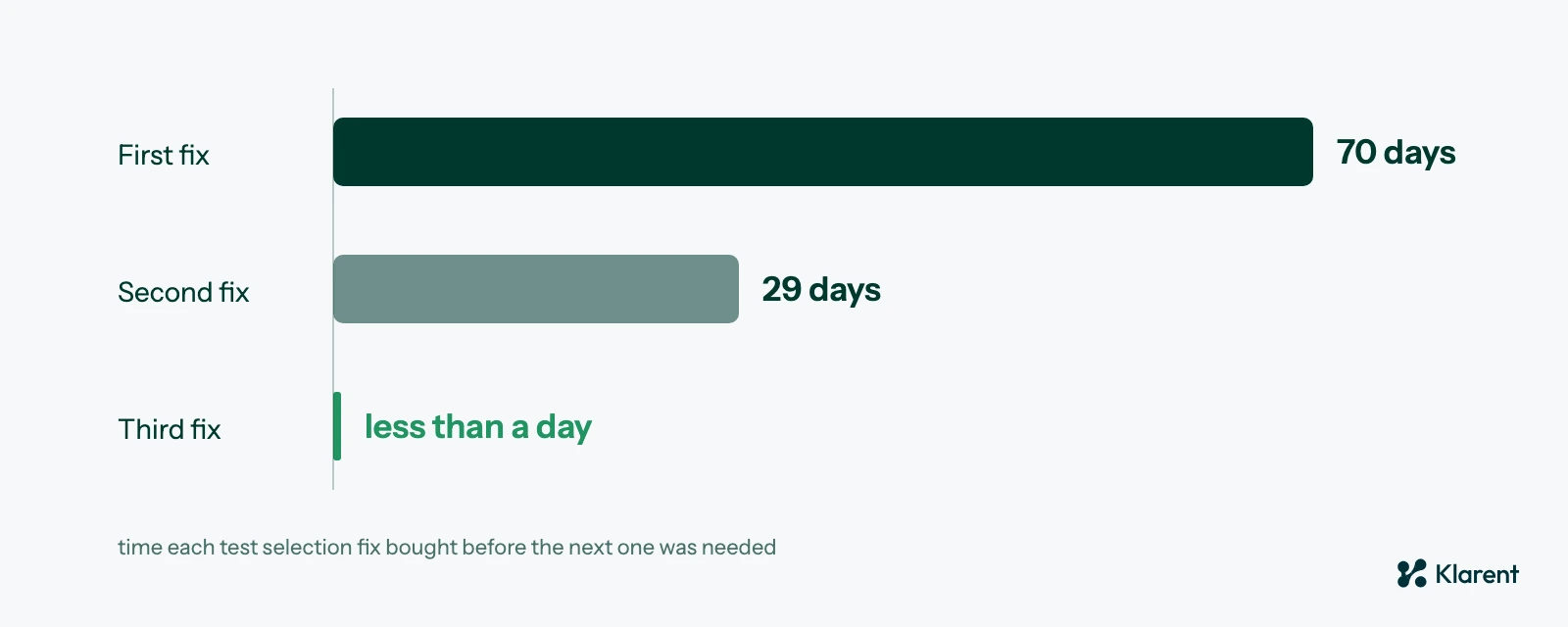 Each fix to test selection bought less time than the last.
That sequence is the most important number in the article. Each fix bought less time than the one before, because the load wasn’t growing in a straight line.
Anthropic’s answer was to redesign test selection so it scales horizontally, and the redesign is holding. It’s good engineering. But I think it answers the wrong question. The question isn’t how to pick the right tests for every pull request faster. It’s whether every pull request should get its own integration test run at all.
I don’t think it should. And I don’t think this is a new idea, because I’ve watched it work at a scale most teams are only now approaching.
Why per-PR testing breaks at agent scale
Per-PR testing rests on an assumption so old we stopped noticing it: changes arrive at human speed. A team of engineers might open a few dozen pull requests a day. Running a serious test suite on each one was expensive, but affordable.
Agents break that assumption in three ways at once:
- More changes. Agents work around the clock, overnight and on weekends.
- Smaller changes. Agents prefer small, granular pull requests, so the same work produces more of them.
- More tests. Agents write tests too, so every suite keeps growing.
The cost of per-PR integration testing is roughly the number of pull requests times the size of the suite. Both are now growing fast, and they multiply.
Test selection attacks the second factor: instead of running everything, figure out which tests each change could affect and run only those. That helps, and the fast part of it should stay. But it doesn’t change the shape of the curve. Every pull request still needs its own run, and something still has to decide what goes in it, at a volume that keeps climbing. You end up building ever more sophisticated machinery to answer, thousands of times a day, a question you could ask far less often.
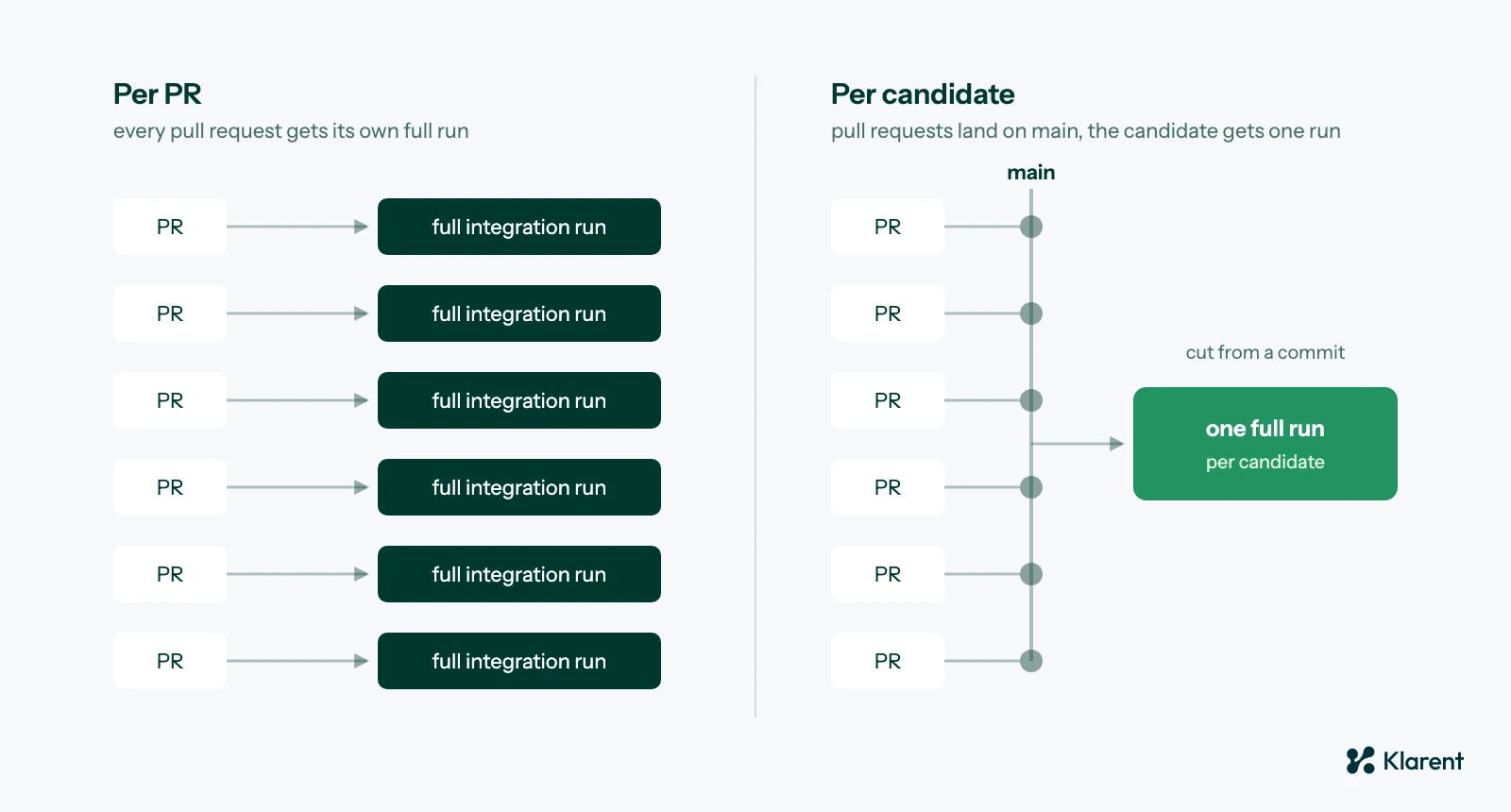 Per-PR testing runs the full suite for every change. Per-candidate testing runs it once.
I’ve seen this before
At Google, we had tens of thousands of “agents” committing to the same codebase every day. We called them engineers.
At that scale, you learn quickly that you can’t run every heavy test on every change. Fast checks ran on each change before it landed. The big end-to-end suites ran against release candidates. Roughly, it worked like this:
- Work landed on the main branch continuously. Unfinished features were hidden behind flags, so half-built work never blocked anything.
- Release candidates were cut from a commit, on a schedule. The candidate was simply the main branch at that point in history.
- The full suites ran against the candidate, once. Not once per change. Once per candidate.
- When something broke, we fixed forward. A fix landed on the release branch and on main, so the next cut didn’t bring the bug back.
- The train left on time. If a fix wasn’t ready by the deadline, the change was reverted or flagged off, and everything else shipped.
Nobody called this Waterfall. Nobody called it anything. It was just the only way to ship at that volume, because per-change integration testing for tens of thousands of engineers was never going to scale.
That’s the volume agents are bringing to every team now. Not because anyone hired tens of thousands of engineers, but because a handful of engineers now direct agents that commit around the clock.
The playbook, with agents in the roles
The Google playbook carries over almost unchanged. What changes is who fills each role.
- Fast presubmit stays on every change. Linting, type checks, unit tests and a small smoke suite run in minutes, so agents can still iterate quickly.
- Builders tag their work draft or ready. Unfinished work can still land on main, behind a flag that keeps it switched off.
- An integrator agent cuts the candidate. It watches every builder and picks the latest commit where everything merged is ready or flagged off. It decides what goes into a candidate, never whether the candidate is good.
- Something independent tests it. The full integration suites run once per candidate, run by a system that doesn’t share the builders’ context.
- Repair agents fix forward. Every fix lands twice: on the candidate, and on main.
- The train leaves on time. If a fix misses the deadline, the culprit is reverted or flagged off, and everything else ships.
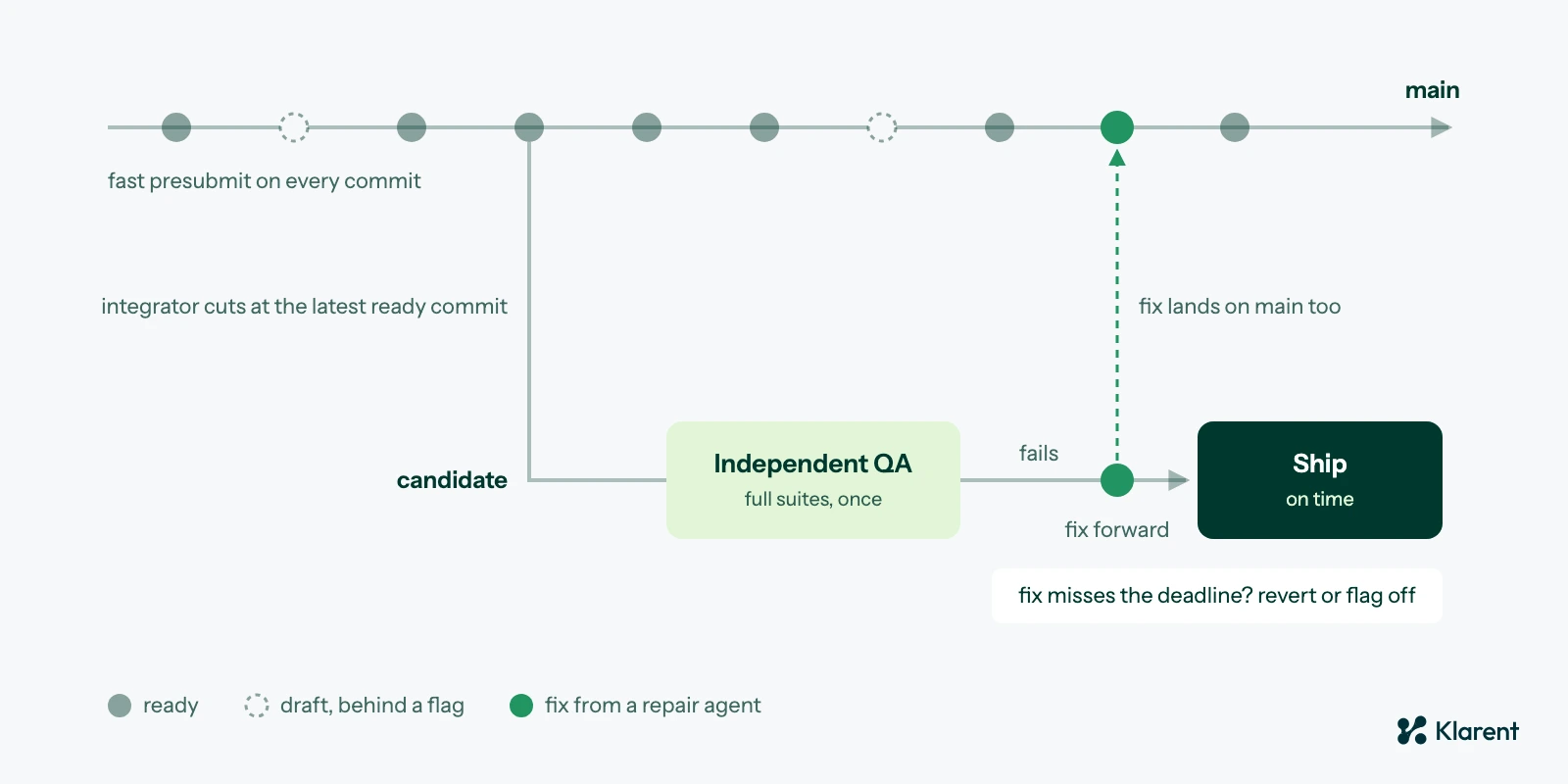 Main keeps moving while the candidate is tested, repaired and shipped.
Cutting from a commit matters more than it looks. If the integrator assembled candidates from hand-picked changes, it would ship combinations of code that never existed together on any branch. A commit is a real state of the codebase, and a candidate cut from one is exactly what was tested.
Isn’t this just Waterfall?
In one way, yes, and I’m fine with that.
Waterfall failed because of its big upfront design: months of specification, then months of building, then the discovery that the spec was wrong. Nothing here brings that back. Specs stay small, work lands continuously, and candidates are cut in hours, not quarters.
What this does bring back is Waterfall’s best idea: build, then verify, as distinct phases. For two decades the industry has tried to collapse those phases into every single change. That made sense when changes were scarce. When changes are abundant, separating the phases again is how you keep verification affordable.
The objections worth taking seriously:
- “Agents need fast feedback.” They do, and they keep it. Fast presubmit checks stay on every change: linting, type checks, unit tests, a small smoke suite. Only the heavy integration suites move.
- “A failed batch is harder to debug than a failed PR.” True. A failed pull request has one obvious culprit; a failed candidate needs culprit finding. That has to be automated, fast and reliable, or this model doesn’t work.
- “At agent volume, every candidate will contain something broken.” This is the serious one, and it’s right. If thousands of changes land between cuts, a perfectly green candidate becomes rare. Pulling every culprit out and waiting for the next train isn’t enough. The candidate has to get fixed, fast.
What comes next
At Google, fixing forward was done by experienced engineers who knew the system and could repair a broken candidate under deadline. That’s the step that doesn’t scale to agent speed by adding people. It needs a network of repair agents: agents that take a failure, work out what actually broke, fix it on the candidate and on main, and hand the result back to be tested again, all before the train is due.
How that network works, and why it has to stay separate from whatever decides the candidate is good enough to ship, is the subject of the next post.
In the meantime: how long do your pull requests wait in the queue?