Code review is dying. Why shift out beats shift left for AI generated code

Published on
Updated on
Code review is dying. An AI coding agent can write 10,000 lines before lunch, while a human reviewer works through a few hundred lines an hour, and less if they are being honest about it. That gap widens with every model release, and the obvious answer is more tests.
Shift left testing, which moves verification earlier in the development cycle, is the standard response. It helps catch defects sooner. It does not help with volume, and it does not answer the harder question of who checks the checker. This article makes the case for shift out, an independent QA layer for AI generated code that verifies behavior without asking anyone to read every line.
Why shift left testing only relocates the bottleneck
Shift left does not close the review gap. It moves it. Once testing starts earlier, humans end up hand maintaining a test suite that grows as fast as the code does. The arithmetic stays the same and only the file changes.
The deeper problem is independence. When the same agent writes the code and the tests, the tests inherit its blind spots. A passing suite then shows that the agent agrees with itself, not that the software behaves the way the business intended. Teams running AI generated code testing this way have not built a verification layer. They have asked one system to grade its own homework.
Shift out testing explained: an independent QA layer for AI generated code
Shift out places an autonomous QA layer outside the system it tests. Its context is independent and derived from the specification, not from the implementation. It is adversarial by design, which means its job is to break the code and not to confirm that it works.
The operating model is simple. Humans review the spec. Agents write the code. An independent QA layer verifies the behavior. Nobody reads 10,000 lines.
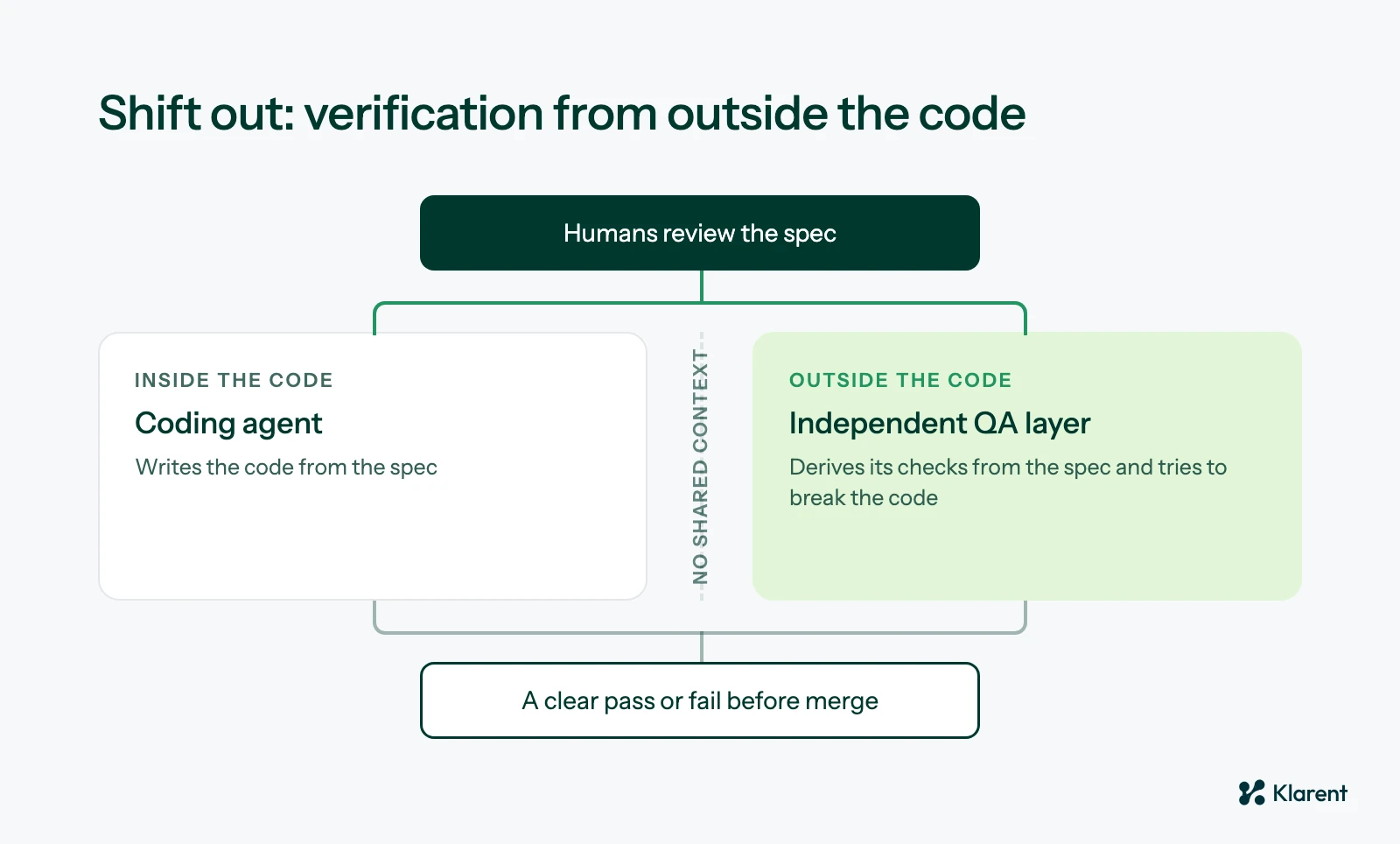 The QA layer works from the spec, never from the code the agent wrote.
Shift out vs shift left testing at a glance
Shift left and shift out answer different questions. Shift left asks when testing should start. Shift out asks who should verify the code and from what context.
| Comparison point | Shift left testing | Shift out testing |
|---|---|---|
| Where verification happens | Earlier in the development cycle, close to the code | Outside the code and outside the agent that wrote it |
| Source of truth | Varies, often tests written by the same author as the code | The specification |
| Main goal | Find defects early | Break the code independently before it ships |
| Human effort | Maintaining a growing test suite | Reviewing the spec |
| Main risk with AI generated code | Tests inherit the blind spots of the agent that wrote the code | Depends on the quality of the spec |
Shift right is a separate axis. It validates the application under real conditions after release. Shift out does not replace shift left or shift right. It adds the one property neither guarantees, a verifier that did not write the code.
What an independent QA layer for AI generated code must do
An independent QA layer for AI generated code has to answer one question before merge, which is whether the code does what the spec says. That takes four properties.
It is independent, so it never shares context with the coding agent. It is derived from the spec, so its checks describe intended behavior and not whatever the implementation happens to do. It is adversarial, so it hunts for failure instead of confirming success. And it is a gate, so a clear pass or fail result sits in the path to production and not in a report nobody opens.
Coverage should extend across functional, regression, performance and security checks, weighted by the risk of the change. A layer that only reruns the tests the coding agent wrote adds speed but no assurance.