Accessibility testing in 2026: What regulators, courts and buyers now expect

Published on
In March 2026 the Dutch consumer regulator, the ACM, reported on its tests of about 100 of the largest Dutch online shops and telecom and energy websites. On 61% it was impossible to place an order with assistive technology, for example because the order button could not be pressed with the keyboard. Another 33% had serious problems.
Since 28 June 2025 the European Accessibility Act has required online shops, banks, telecoms and travel companies to make the services they provide to consumers accessible, and regulators have started checking. In the US, website accessibility lawsuits filed in federal court rose 27% in 2025, according to the law firm Seyfarth Shaw. This post covers what has happened, what automated testing and AI can and cannot check, and what to do now. It is not legal advice. For the basics, see our guide to accessibility testing at enterprise scale, or watch the video below on finding the gaps that scanners miss.
In Europe, the Accessibility Act now applies
The European Accessibility Act (EAA) covers services provided to consumers, including e-commerce, consumer banking, phone and internet services, the websites, apps and e-tickets of passenger transport, e-books, and access to TV and streaming. It applies to any company that offers these services to consumers in the EU, wherever it is based, and each member country enforces it through its own law. The technical yardstick is expected to be EN 301 549, the European standard built on WCAG, the Web Content Accessibility Guidelines.
European regulators have started checking
As of mid-November 2026 we found no fine published under any national EAA law. Regulators are testing, publishing what they find and warning first.
| Country | What has happened so far |
|---|---|
| Netherlands | In the ACM’s tests of about 100 large webshops and telecom and energy websites, ordering with assistive technology was impossible on 61%. By June it had visited the ten large webshops with the biggest problems, and said those still falling short at a re-test risk a fine. |
| France | In first results in September 2026, the regulator DGCCRF said more than half of the online shops it had checked since January had failings. A court in Caen gave Carrefour six months to make its site and app accessible, under a daily penalty reported as €500. |
| Germany | Fines under the national law go up to €100,000. By 1 June 2026 the national market surveillance authority was working through almost 700 reports. |
| Sweden | The regulator PTS had opened 28 supervision cases against e-commerce services by 3 March 2026. |
Carrefour argued that meeting 71% of the requirements was enough. The court rejected that, calling accessibility an obligation of result. A board member of the Dutch regulator made the same point: to a technician, fixing seven of ten barriers looks good, but if the other three remain, disabled customers still face a major barrier to completing an order.
In the US, lawsuits and buyers set the pace
Plaintiffs filed 3,117 website accessibility lawsuits in US federal court in 2025, up 27% from 2,452, according to the law firm Seyfarth Shaw. In the count of UsableNet, an accessibility vendor that also covers New York and California state courts, 70% of digital accessibility lawsuits were against e-commerce companies. Buyers ask too: US federal guidance tells agencies to require an Accessibility Conformance Report (ACR) for each off-the-shelf product they buy. Public bodies have their own deadline: under a Department of Justice rule, state and local governments with a total population of 50,000 or more must meet WCAG 2.1 AA by 26 April 2027, and smaller ones by 26 April 2028.
Other countries have rules of their own. In the UK, the Equality Act 2010 requires anyone providing a service to the public to make reasonable adjustments for disabled people. In Canada, Ontario has required organizations with 50 or more employees in the province to make their websites meet WCAG 2.0 AA, with two exceptions, since 2021.
Why a clean scan is not a pass
WebAIM’s February 2026 scan of the top one million home pages found detected WCAG failures on 95.9% of them. Free scanners such as axe-core, WAVE and Lighthouse catch errors like these and belong in every release, but they can only check what a rule can decide. The W3C says no tool alone can determine whether a site meets accessibility standards, and by our own count only 10 of the 55 WCAG 2.2 criteria at levels A and AA can be checked by a script alone. That is where AI earns its place: on many of the other 45, it can flag likely problems with the evidence attached, for a person to confirm.
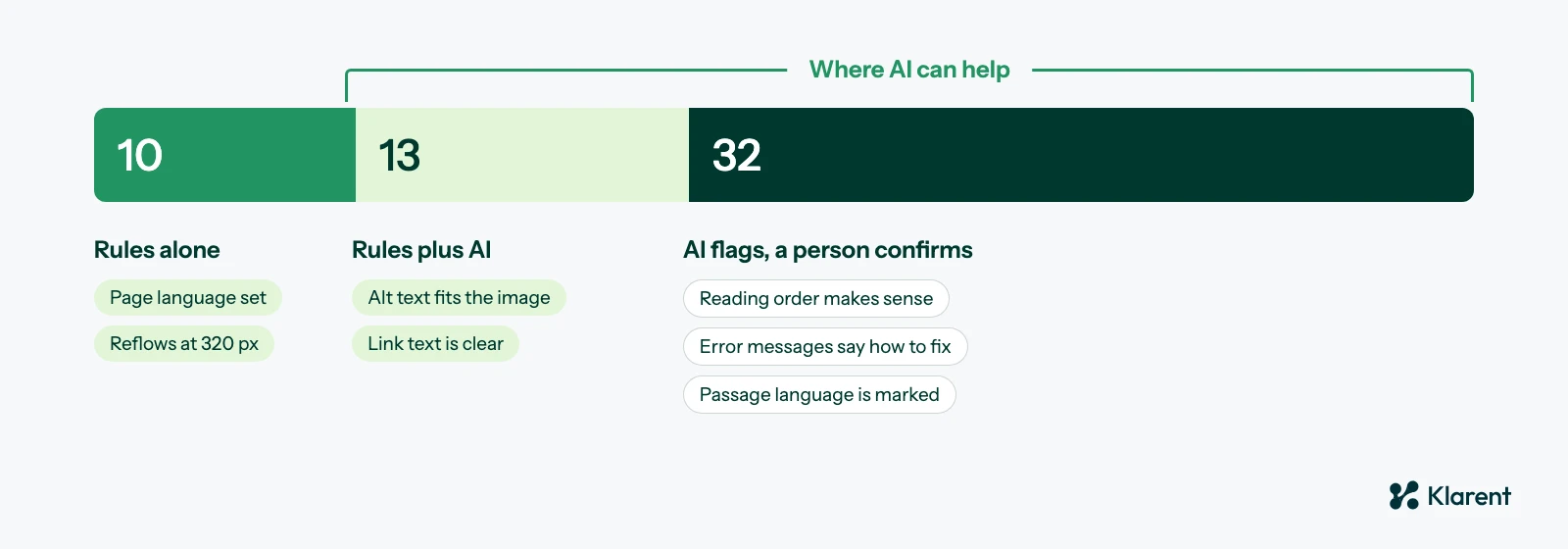 Rules settle 10 criteria on their own. On many of the other 45, AI can flag likely problems with evidence, and a person confirms. Our count, from one team’s checklist.
We saw the gap in November 2026 on the home pages of a large travel booking site and a large furniture retailer. axe-core found no failures on either page, yet three of our tests in Klarent failed:
- Two large photos had the alt text “[unpopulated]”, which a screen reader reads aloud. A vision model compared each photo with its alt text and rejected both.
- With WCAG’s text spacing settings applied, the search bar cut off “Check-out date” and the room count.
- The header’s focus ring measured 2.07:1 against the dark blue, below the 3:1 that WCAG asks for.
Two other tests passed: a hotel search done with the keyboard alone, and product photos whose alt text matched what they showed.
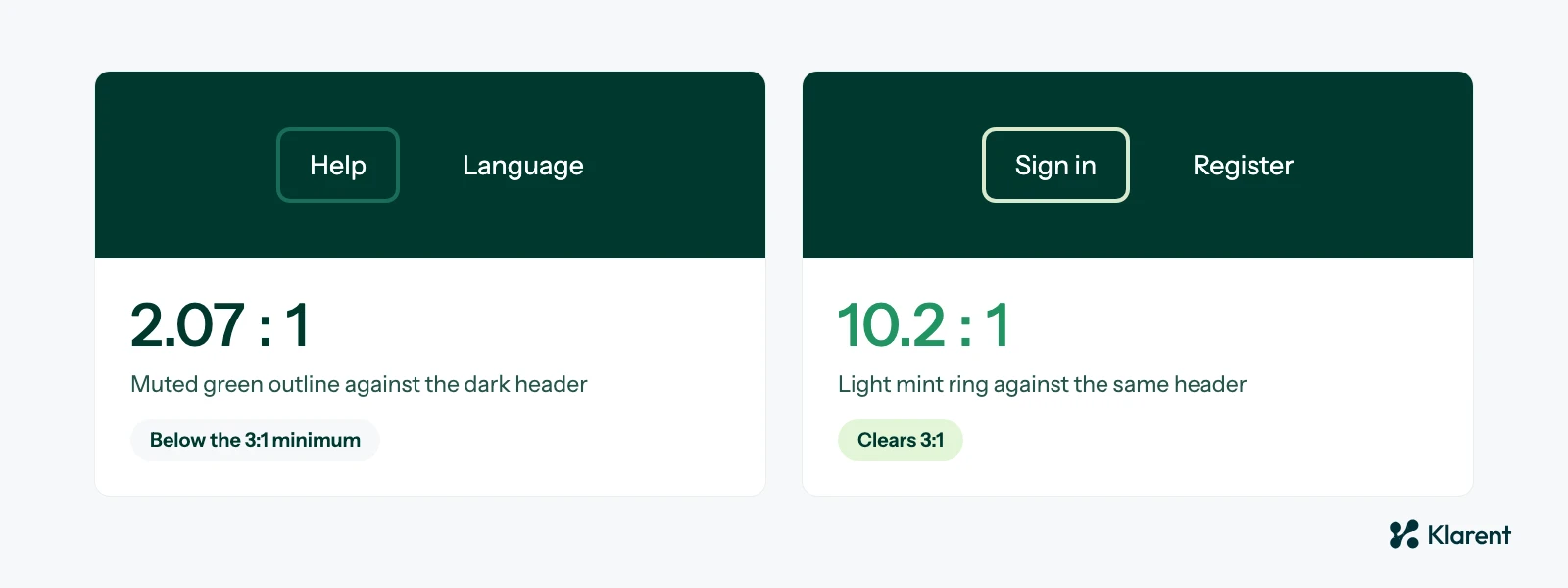 The ring on the left is easy to see in a screenshot, yet it fails the calculation.
A vision model looking at that screenshot called the ring clearly visible. The calculation says it fails.
Where AI helps, and where it doesn’t
Language models can help with judgment questions that rules cannot answer, such as whether link text makes sense in its context. A September 2026 preprint that gave each of 40 WCAG requirements its own vision agent found 86% of the issues experts had reported on 11 scholarly platforms, against 36% for axe-core. But only 56% of what those agents flagged was correct; the rest were false positives. And in a 2025 benchmark on PDF documents, judging alt text quality was one of the hardest tasks for every model tested; the same benchmark concluded that rule-based tools are better at technical checks and language models at judging meaning and context.
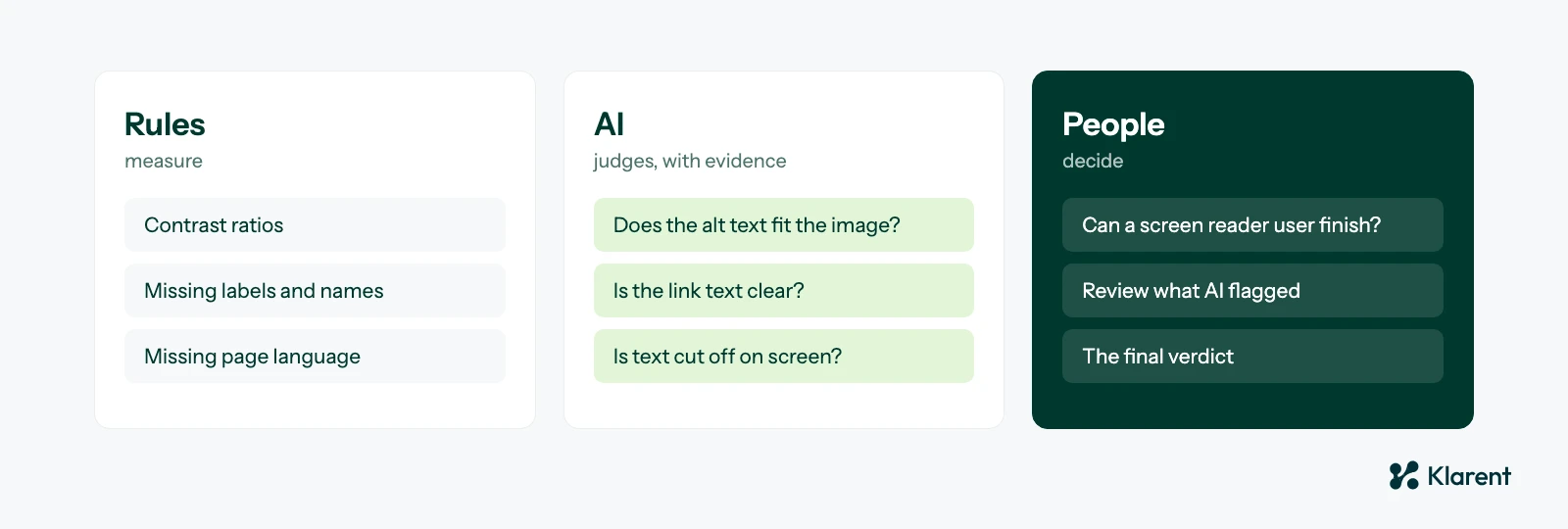 Rules for the mechanical checks, AI for the judgment checks, people for the verdict.
What to do now
- Find out which rules apply in each market you sell in: the Accessibility Act in the EU, ADA lawsuits and buyer requests for an ACR in the US, and local laws such as the UK’s Equality Act or Ontario’s web rules elsewhere.
- Test journeys, not just pages. Sign-up, login and checkout sit behind forms that a one-page scan does not get past on its own.
- Run automated checks on every release, inside the end-to-end tests you already maintain.
Where Klarent fits
Klarent runs accessibility checks inside the end-to-end tests your team already writes in plain language, so a check can log in, fill in a form and reach the checkout page before it measures anything. Where a rule can decide, the test measures. Where it cannot, the test can ask a vision model and record its answer and reason with the run, for a person to review. To see that on one of your own journeys, get in touch.